 Ideal Spectral Interpolation
  Stretch Operator
  Signal Operators Contents
Global
Contents
Signal Operators Contents
Global
Contents  Global
Index Index Search
Global
Index Index Search
Zero padding consists of appending zeros
to a signal. It maps a length  signal to a length
  signal, but
  need not be an integer multiple of :
![$\displaystyle \hbox{\sc ZeroPad}_{M,m}(x) \isdef \left\{\begin{array}{ll}
x(m), & 0 \leq m \leq N-1 \\ [5pt]
0, & N\leq m \leq M-1 \\
\end{array}\right.
$](Zero Padding-Dateien/img957.png)
![$\displaystyle \hbox{\sc ZeroPad}_{10}([1,2,3,4,5]) = [1,2,3,4,5,0,0,0,0,0]
$](Zero Padding-Dateien/img958.png)
 represents a
signal starting at time 0 and extending for samples. If,
on the other hand, we are zero-padding a spectrum,
or we have a time-domain signal which has nonzero samples for negative time
indexes, then the zero padding is normally inserted between samples
represents a
signal starting at time 0 and extending for samples. If,
on the other hand, we are zero-padding a spectrum,
or we have a time-domain signal which has nonzero samples for negative time
indexes, then the zero padding is normally inserted between samples  and
and  for odd (note that
  ), and similarly for even . Thus, for spectra,
zero padding is inserted at the point
), and similarly for even . Thus, for spectra,
zero padding is inserted at the point  (
(  ).
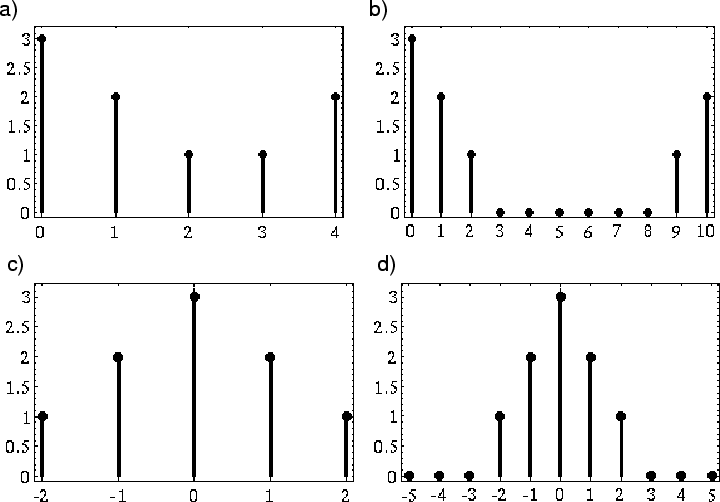
Figure 7.5
illustrates this second form of zero padding. It is also used in conjunction
with zero-phase
FFT
windows (discussed further in §7.4.4
below).
).
Figure 7.5
illustrates this second form of zero padding. It is also used in conjunction
with zero-phase
FFT
windows (discussed further in §7.4.4
below).
 |
Using Fourier theorems, we will be able to show that zero padding in the time domain gives bandlimited interpolation in the frequency domain. Similarly, zero padding in the frequency domain gives bandlimited interpolation in the time domain.
It is important to note that bandlimited interpolation is ideal interpolation in digital signal processing.
Ideal Spectral Interpolation Stretch Operator Signal Operators Contents
Global
Contents Global
Index Index Search
 (automatic links
disclaimer)
(automatic links
disclaimer) ![$ X=[3,2,1,1,2]$](Zero Padding-Dateien/img28.png) plotted
over the domain
plotted
over the domain ![$ k\in [0,N-1]$](Zero Padding-Dateien/img29.png) where
where  (i.e., as the spectral
samples would normally be held in a computer array).
(i.e., as the spectral
samples would normally be held in a computer array). 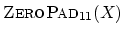 .
.  plotted over the domain
 ![$ k\in [-(N-1)/2,(N-1)/2]$](Zero Padding-Dateien/img32.png) which is more natural for
interpreting
which is more natural for
interpreting