 Coherence
  Autocorrelation
  Signal Processing Analysis Contents
Global
Contents
Signal Processing Analysis Contents
Global
Contents  Global
Index Index Search
Global
Index Index Search
Welch's method (or the periodogram method) for estimating power spectra
[36]
is carried out by dividing the time signal into successive blocks, and
averaging squared-magnitude DFTs of the signal
blocks. Let  denote the
  th block of the signal
  ,
and let
,
and let  denote the number of blocks. Then the PSD estimate is given by
 '' to denote time averaging across blocks (or ``frames'') of
data indexed by .
'' to denote time averaging across blocks (or ``frames'') of
data indexed by .
However, note that 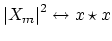 which is circular autocorrelation.
To avoid this, we use zero
padding in the time domain, i.e., we replace
above by
which is circular autocorrelation.
To avoid this, we use zero
padding in the time domain, i.e., we replace
above by ![$ [x_m,0,\ldots,0]$](Welch's Method for Power Spectrum Estimation-Dateien/img1493.png) . However, note that although the ``wrap-around problem'' is fixed,
the estimator is still biased. That is, its expected
value is the true autocorrelation
. However, note that although the ``wrap-around problem'' is fixed,
the estimator is still biased. That is, its expected
value is the true autocorrelation  weighted by
  . This bias is equivalent to having multiplied the correlation
in the ``lag
domain'' by a triangular window (also called a ``Bartlett window''). The
bias can be removed by simply dividing it out, as in Eq. (E.2).
However, it is common to retain this inherent Bartlett weighting since it merely
corresponds to smoothing the power spectrum
(or cross-spectrum)
with a sinc
. This bias is equivalent to having multiplied the correlation
in the ``lag
domain'' by a triangular window (also called a ``Bartlett window''). The
bias can be removed by simply dividing it out, as in Eq. (E.2).
However, it is common to retain this inherent Bartlett weighting since it merely
corresponds to smoothing the power spectrum
(or cross-spectrum)
with a sinc kernel; it also down-weights the less reliable large-lag estimates, weighting
each lag by the number of lagged
products that were summed.
kernel; it also down-weights the less reliable large-lag estimates, weighting
each lag by the number of lagged
products that were summed.
For real signals, the autocorrelation is real and even, and therefore the power
spectral density is real and even for all real signals. The PSD  can interpreted as a measure of the relative probability that the
signal contains energy at
frequency
can interpreted as a measure of the relative probability that the
signal contains energy at
frequency 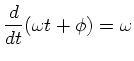 .
Essentially, however, it is the long-term average energy density vs. frequency
in the random process
.
Essentially, however, it is the long-term average energy density vs. frequency
in the random process  .
.
At lag zero, the autocorrelation function reduces to the average power (root mean square) which we defined earlier:
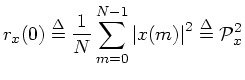
Replacing ``correlation'' with ``covariance'' in the above definitions gives the corresponding zero-mean versions. For example, the cross-covariance is defined as
![$\displaystyle \zbox {c_{xy}(n)
\isdef \frac{1}{N}\sum_{m=0}^{N-1}\overline{[x(m)-\mu_x]} [y(m+n)-\mu_y]}
$](Welch's Method for Power Spectrum Estimation-Dateien/img1499.png)
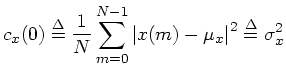
 equals the variance
of the signal :
equals the variance
of the signal :
Coherence Autocorrelation
Signal Processing Analysis Contents
Global
Contents Global
Index Index Search
 (automatic links
disclaimer)
(automatic links
disclaimer) 