 Dual of the Convolution Theorem
  Application of the Shift Theorem to FFT Windows
  The Fourier Theorems Contents
Global
Contents
The Fourier Theorems Contents
Global
Contents  Global
Index Index Search
Global
Index Index Search
Theorem: For any  ,
,
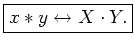
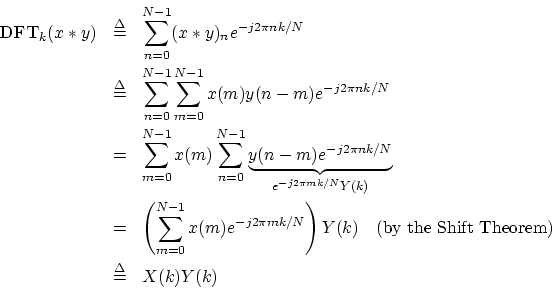
This is perhaps the most important single Fourier
theorem of all. It is the basis of a large number of applications of the FFT.
Since the FFT provides a fast
Fourier transform, it also provides fast convolution, thanks to the convolution theorem. It turns out that using the
FFT to perform convolution is really more efficient in practice only for
reasonably long convolutions, such as  . For much
longer convolutions, the savings become enormous compared with ``direct''
convolution. This happens because direct convolution requires on the order of
. For much
longer convolutions, the savings become enormous compared with ``direct''
convolution. This happens because direct convolution requires on the order of
 operations
(multiplications and additions), while FFT-based convolution requires on the
order of
operations
(multiplications and additions), while FFT-based convolution requires on the
order of  operations.
The simple matlab
example in Fig. 7.11
illustrates how much faster convolution can be performed using the FFT.7.8 We see that for a length  convolution, the FFT is approximately 300 times faster in Octave, and 30 times
faster in Matlab. (The conv routine is much faster in Matlab.)
convolution, the FFT is approximately 300 times faster in Octave, and 30 times
faster in Matlab. (The conv routine is much faster in Matlab.)
N = 1024; % FFT much faster at this length t = 0:N-1; % [0,1,2,...,N-1] h = exp(-t); % filter impulse reponse H = fft(h); % filter frequency response x = ones(1,N); % input = dc (any signal will do) Nrep = 100; % number of trials to average t0 = clock; % latch the current time for i=1:Nrep, y = conv(x,h); end % Direct convolution t1 = etime(clock,t0)*1000; % elapsed time in msec t0 = clock; for i=1:Nrep, y = ifft(fft(x) .* H); end % FFT convolution t2 = etime(clock,t0)*1000; disp(sprintf([... 'Average direct-convolution time = %0.2f msec\n',... 'Average FFT-convolution time = %0.2f msec\n',... 'Ratio = %0.2f (Direct/FFT)'],... t1/Nrep,t2/Nrep,t1/t2)); Octave: Average direct-convolution time = 95.17 msec Average FFT-convolution time = 0.32 msec Ratio = 299.20 (Direct/FFT) Matlab: Average direct-convolution time = 15.73 msec Average FFT-convolution time = 0.50 msec Ratio = 31.46 (Direct/FFT) |
A similar program produced the results for different FFT lengths shown in
Table 7.1.7.9In this softwar environment, the FFT is faster
starting with length  , and it is never
significantly slower at short lengths where ``calling overhead'' dominates.
, and it is never
significantly slower at short lengths where ``calling overhead'' dominates.
See Appendix I for further discussion of the FFT and its applications.
Dual of the Convolution Theorem Application of the Shift Theorem to FFT Windows The Fourier Theorems Contents
Global
Contents Global
Index Index Search
 (automatic links
disclaimer)
(automatic links
disclaimer)  ) using Matlab
5.2 on an 800 MHz Athlon Windows PC.
) using Matlab
5.2 on an 800 MHz Athlon Windows PC.